Tuesday, July 12, 2011

India play out draw against Maldives

Sunil Chhetri scored India's only goal
By Arunava Chaudhuri - AFF Indian correspondent

India were held to a one-all draw by neighbours the Maldives in an international friendly match at the National Stadium in Male yesterday. India went ahead through Sunil Chhetri, while Mukhthaar Naseer restored parity for Maldives before the break.

After the game interim coach Armando Colaco said, "It was a tough match. We did create our chances and I'm happy with the performance of the boys."

"The World Cup Qualifier against UAE stays our priority. There’s always a bit of experimentation in Friendlies and we tried to make most use of it," Armando added who did not make any substitutions.

After early chances on both sides India took the lead in the 18th minute through a Sunil Chhetri header off a Steven Dias corner. Thereafter India put pressure on their rivals with the Indian midfield in control with Jeje and Chhetri a constant threat. Jeje's missed a golden opportunity in the 43rd minute when he was send free by Chhetri but his shot hit the post. Only a minute later the Maldives equalised in the 44th minute when Mukhthaar Naseer curled in a nice shot past Subrata Pal.

After the break it was mainly the Maldives as the islanders put pressure on their bigger rivals, but India did have their chances with Jeje having the best. It stated one-all in the end.

India were the better side in the first half, while the Maldives had more of the game after the break and the final result is a fair account of the match.

India now travel to Doha to face Qatar on July 17 at the Al Sadd Stadium to continue their preparations for the 2014 FIFA World Cup - Asian Round 2 qualifier against the United Arab Emirates on July 23 & 28.


INDIA

Subrata Pal; Samir Naik, Gouramangi Moirangthem Singh, Raju Eknath Gaekwad, Debabrata Roy; Steven Benedic Dias, Climax Lawrence, Mehtab Hussain, Syed Rahim Nabi; Jeje Lalpekhlua, Sunil Chhetri


Sunday, July 10, 2011

Fowler looking forward to Thai challenge

By Kitinan Sanguansak - AFF Thai correspondent
Fowler at is first training session
as a Muang Thong United player
Former Liverpool striker Robbie Fowler is looking forward to a new challenge after completing his shock move to Thailand Premier League champions Muang Thong United.
The 36-year-old dubbed the “God” by the Kop for his scoring exploits during his eight-year stay with the Merseyside club joined Muang Thong on a one-year contract with an option for an extension, with the club saying they spent around Bt20 millions for his services.
Fowler, who also won 26 caps and scored seven goals for England, was officially unveiled as Muang Thong’s marquee signing yesterday in a media room crammed by a big group of reporters at the the club’s home ground, Yamaha Stadium.
Even though the Englishman still has to wait for his first appearance for his new employers, with the second leg of the country’s top-flight league to resume at the end of this month, the club’s new recruit has already caused "Fowler Fever", with dozens of fans, several of them sporting shirts with his name, clamouring for his autograph outside the room.
Fowler greeted the local media, saying “Sawasdee Krub” which drew a big applaud before stating that he was happy to join the club which was as successful as Muang Thong, who have won successive league titles in the past two seasons.
“I want to say “big thank” to everyone involved in bringing me to the club. They have been a very successful club over the past few years. I hope it will continue after this.
“I’m looking forward to work with (Muang Thong coach Henrique) Calisto. It’s great challenge for me. I can’t wait to get back to the pitch and show you that I’m still good on the field,” said Fowler.
Fowler, who also played for Blackburn Rovers and Leeds United in England, dismissed a suggestion that playing in TPL was a step backward of his career.
“I think it’s unjust (to say the TPL standard is low). The league has progressed well over past few years and the teams got better. The professionalism of Muang Thong is fantastic.
“I’ve played for a few clubs and I think Muang Thong’s professionalism is unbelievable. I’m really impressed with that. Hopefully, with me now in the team, it gonna be better.”
Asked whether he was concerned with the humid conditions, Fowler believed he would have no problem in adjusting himself to the weather.
“Yeah, the weather is hot. I did play in Australia and I think the conditions were similar. It’s difficult to say whether you can adapt to the new conditions until you get there. But, I don’t see it as a problem.
“As a player, you should be able to adapt to wherever you play. I’m looking to play my football regardless of the weather.”
Having already had his first training with the new teammates, Fowler appeared relaxed on the adaptation to the team.
“It’s not totally difficult when you come to the new team. You come to know the lads with different names. I’ve changed clubs over past few years. I know it would take time to adapt to the certain things.
“But, I’m sure it would be fine. It’s good experience to train with them on the pitch and I’ll kick it on from that”
While admitting that scoring was what he loved to do, Fowler insisted the team would come first when asked whether he wanted to become the top scorer in the league, with the current leader on the scoring chart on 12 goals.
“It’s obviously good when you score the goals but as long as the team is successful. For me, the most important is the placing of the team in the table come the end of the season.” 
   

Japanese youngsters shine in Mexico

By Nobuyuki Tosey

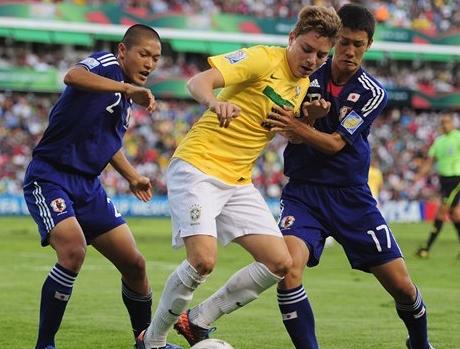
Naoki Kawaguchi and Hiroki Akino
battle with Brazil's Adryan (Getty Images)
As the final whistle blew, many of the defeated Japanese players broke into tears. Consoled by the victorious Brazilian coaches and players, the two teams left the pitch to the applause of the fantastic Mexican crowd; a wonderful illustration of just how much Japan had impressed at this tournament.

Japan's World Cup had ended in the midst of the most unlikely of comebacks and that they had almost managed to pull it off made it all the more agonising. But what better indication of how far Japan had come, than the loss to Brazil in the quarter finals of the World Cup being met with such disappointment.

And they have come far. One win in six in the lead up to the tournament suggested that qualification from a group consisting of France, Argentina and Jamaica was unlikely. But not only did they qualify, they won the group; beating Jamaica and Argentina and arguably deserving a win in a draw against France, before a faultless 6-0 win over New Zealand in the last 16.

Japan had earned plaudits for not only their results, but the tactically mature manner of their performances. Coach Hirofumi Yoshitake had organised his team to focus on possession and collective effort all over the pitch, switching between a 4-2-3-1 and a 4-1-3-1 formation to achieve this. An average of 60% possession, 11 goals scored and 2 conceded across 4 games meant that Japan would enter their quarter final with confidence riding high throughout the squad.

Furthermore, unlike many other countries where the tournament was going unnoticed, the performance of this U17 team was making news here in Japan and for a country still so in awe of Brazil's football heritage, a win against them at any level would be seen as a significant step in Japan's ever-growing football reputation.

     
Brazil
Hirofumi Yoshitake
Coach Yoshitake had a hard job in balancing the confidence in his side and being wary of the threat of Brazil. But he was clever with his tactics: bold with the use of 4-1-3-1-1 formation that produced six goals against New Zealand, but conservative with his personnel; as he deployed the defensive minded Kida in the middle of the attacking midfield three and left the offensive minded Matsumoto on the bench.

But with so much of Japan's success this tournament stemming from their possession game, Japanese hearts sank upon seeing the state of the pitch. The heavy rain - that had already led to a game being abandoned this World Cup - had taken its toll and despite the attempts from the Japanese to stick to their passing game, it was clear from early on that the conditions wouldn't allow it.

As I have mentioned in my previous article, these tournaments are all about broadening these young players' footballing education and for the Japanese, their encounter with Brazil would prove to be a ruthless demonstration of the increased level of opposition that comes with the transition from youth to professional football.

In Adryan and Ademilson Brazil possess two scintillating talents; along with Germany's Samed Yesil and Ivory Coast's Souleymane Coulibaly they have been the most exciting players at the tournament and the pair would ultimately prove to be the architects of Japan's defeat.

After a scrappy start it wasn't long before Brazil got the opening goal. Adryan showcased his ability from set pieces with a perfect corner for Leo to head past Nakamura. The level of defensive organisation we had to come to expect from Japan was non-existent and the young team were perhaps slightly overawed by the occasion.

With a 1-0 lead, Brazil were happy to sit back and hit on the counter. Japan had experienced a similar scenario before; as France adopted a similar tactic having gone ahead in their group game. Although Japan were able to open them up with prolonged spells of possession on that occasion, this time the insistence to stick to their passing game was admirable yet naïve given the conditions and Japan struggled to create much before the interval.

It wasn't long after half time that Brazil struck again through a moment of sheer quality. Guilherme burst down the left wing, whipped an early ball into the box and despite Iwanami doing his best, the ball couldn't be cut out. Ademilson then showed exactly why he is deserving of his burgeoning reputation, as in one fluid movement he cushioned the ball and hit a precise shot in the far bottom corner with his left foot.

Japan found themselves two goals down for the first time this tournament. Desperation began to creep into their game and with it the assurance and discipline we had come to come expect began to disappear. Long and hopeful balls became the means of attack and previously reliant figures such as the captain Iwanami were making errors that Japan were lucky not to concede from.

Japan needed a moment of inspiration and Ishige almost provided it. Collecting the ball on the edge of the area, Japan's top scorer cut in on his left and hit a rasping shot that struck the bar. It was a moment that would ultimately prove pivotal. Had that gone in, with a one goal defecit and plenty of time left the momentum may well have swung in favour of Japan. But soon after Adryan produced a moment of brilliance to all but end the tie.

After Nakamura saved well from a Misael shot across goal, the stocky number 10 picked up the ball on the corner of the penalty area with not much danger in sight. Executing a Cruyff turn that the man himself would have been proud of, Adryan left Kawaguchi for dead and hit a thunderous strike with his left foot that beat Nakamura at his near post.

The goal seemed to settle Japan, with nothing to lose they looked relaxed and with around 15 minutes to go they pegged one back. Ishige lifted a ball over the top and for one of the first times in the match Japan got in behind the Brazilian back four. The two substitutes combined as Takagi crossed for the late arriving Nakajima to finish calmly.

Japan were giving all they had to get the necessary two goals, but it wasn’t until the 88th minute that they got a goal back. A deep corner by Ishige was cushioned back across goal and after it clipped the cross bar, Hayakawa was on hand to nod into the empty net.

You had the feeling that Japan would get one more chance and they did. Ishige burst into the area and somewhat erratically fired across goal. Reminiscent of Paul Gascoigne against Germany in Euro 96, Nakajima came so close to getting on the end of the cross-cum-shot to tap home the equaliser but failed to make contact.

Brazil held on for the win but the final whistle was met with relief rather than ecstasy in the knowledge that this Japan team had pushed them all the way.  

     
Overall Review 
With the group of players playing far beyond the level most had expected, in terms of performance there is little to criticise, neither is there much point in doing so given the age group. What should be looked at is the state of youth development, the consequent players it’s producing and what can be improved.

As I mentioned earlier, the influence of Brazil on Japanese football should not be underestimated. Brazilian players continue to play a significant role in the J.League today, but the influence dates back a number of footballing generations.

Fellow Asian Football Feast contributor Matthew Kenny wrote on the subject: “The likes of Zico, Dunga and Leonardo had a hugely positive impact on Japanese football, teaching their hard-working teammates the value of technique and good attitude”.

Indeed one of the best qualities that the Japanese possess is that they work so hard for each other and are so disciplined in their roles. This was apparent with this young team as the levels of physical fitness displayed by the players were incredibly high and allowed them to compensate for having lesser height and physique than their opposition.

But what has come on a lot in recent years in the Japanese game is the tactical nous shown by the coaches and players and this was by far the most encouraging sign given by this group. Yoshitake was one of the few coaches to use the entirety of his squad and the ease at which players came into the side and adapted to the changing formations was phenomenal. Having such a high level of tactical maturity and the fitness needed to put Yoshitake’s plans into practice meant that Japan were probably the most impressive 'team' at the tournament. 

However, it seems that the 'value of technique' appears to have been lost along the way a little. I wouldn't go so far as to say that Japan have compromised technical ability over other attributes, as at the higher end of Japanese football the technique exhibited regularly by players such as Yasuhito Endo, Keisuke Honda and young prospects Takashi Usami and Ryo Miyaichi would suggest otherwise.

But the gulf between this U17 team's technical ability and their opposition was often telling. If you look at the goals Japan conceded this tournament, they were all examples of technically superior players undoing Japan's collective containment effort. Compare this to Japan's goals and even in the rout of New Zealand Japan had to work much harder for their goals to compensate for the lack of technique.

To paraphrase what Dutch coach Raymond Verheijen recently noted on twitter: developing football countries should focus on technical and tactical development to catch up with the top nations and not rely on fitness.

It’s something that is being addressed; Nobuyuki Uenoyama, head of the J.League's technical committee recently said: "Most of the people who trained the Samurai Blue into who they are today are high school teachers". Although increased numbers of pro-licensed coaches in recent years have improved the situation for this group of youngsters, its still evident that level of technique is not yet up to the standards of the leading nations.

Finally and perhaps this point is a little harsh, it appears that Japan suffers from the age old problem of pigeonholing players due to their physical attributes. Of course, the demographic of Japan plays a part in the type of players Japan produces and so to expect a Drogba-esque striker is pointless.

However, as the tallest players were the three goalkeepers and the two centre backs Ueda and Iwanami it seems to suggest that it’s true to an extent. Japan’s national team currently have a problem with a lack of a natural striker and this was very much the case for this U17 team. If Japan are to compete at a higher level they need to be producing a wider variety of attacking players, not just small industrious types that make intelligent runs.

    
Notable Individuals 

Naomichi Ueda - The tall, ball-playing centre back was the only ever present player for Japan and outshone his centre-back partner, the captain Iwanami. Weak on the back foot, but strong in the air and a good reader of the game, he was often seen stepping up to dispossess deep lying forwards on a number of occasions. Furthermore, just as Ryo Miyaichi had done in the previous U17 World Cup, both Ueda and Muroya showed that the high school system can still produce high level players and it’s not surprising to see a number of J.League Clubs chasing his signature.


Naoki Kawaguchi - Although the full back didn't start in the first game against Jamaica, he took his chance against France and went on to be the most improved player during the team's time in Mexico. His ability to get forward gave the team the needed width to stretch their opposition and create gaps for the trio of attacking midfielders to exploit. Defensively he has the intensity in terms of closing down that is so often lacking in full backs of the attacking mould and positionally it all seems to come very naturally to him. I would say that he is the most likely to push on from this group.


Fumiya Hayakawa - The full back/winger was my player of the tournament for Japan. A good mix of industriousness complimented by end product, he finished the tournament with an impressive 3 goals and 2 assists. Would like to see more work done on his defensive qualities and see him develop as a full back as he doesn't have the ability to be a midfielder at the top level. If he does concentrate on that part of his game he and Kawaguchi could well be the left and right back pairing for Albirex Niigata in a couple of years.

    
The Coach 
Hirofumi Yoshitake’s contribution to the team’s success at this tournament should not be underestimated. Getting such a young team to stick to such a patient approach is admirable enough, that he was able to get results with the system is quite outstanding. He is already looking ahead, stating that he “would like to work hard to narrow those gaps [between Japan and the top teams] and bring another team to the world championship with those who were born in 1996.” With Yoshitake in charge, the next generation will certainly be in good hands.


Saturday, July 9, 2011

Djohar Arifin Husin elected new PSSI Chairman

By Paul Williams

Djohar Arifin Husin was today elected as the Chairman of the PSSI, gaining 61 votes at the PSSI Congress.


Held at the Sunan Hotel in Solo, Central Java, the Congress has been shrouded in controversy for months with candidates pulling out late, claims of vote-buying and intervention from FIFA.


Djohar Arifin Husin is a current advisor to the Indonesian Minister of Sport, former Chairman of the North Sumatra Province FA and secretary general of KONI, the national sports committee of Indonesia.


The result is seen as a great one for Indonesian football, with the opportunity for actual change and reform now a real possibility.


More to follow...


Fowler goes Thai

By Kitinan Sanguansak - AFF Thai correspondent
Fowler arrives in Thailand
Thai fans’ dreams of watching a familiar name on TV play in the Thailand Premier League is only a step away after former Liverpool striker Robbie Fowler flew in yesterday to thrash out his shock move to TPL champions Muang Thong United.
The 36-year-old, who scored 183 goals during his eight-year stay with the Merseyside club, is set to become by far the highest profile player to have play in the country’s top flight, with some details on his contract still to be ironed out.
Fowler’s arrival was the vindication of the giant leap the league has taken over the past few years, which saw a sharp increase of attendance in the competition that not so long ago struggled to draw interest from the public.
Observers believe the signing of the player nicknamed the “God” for his scoring exploits would be a big boon for the league in term of its growth, a notion that was strengthened by positive reaction of fans in general not only a group of Muang Thong supporters, some of those already indicating that they wanted to watch the games featuring Fowler.
A group of fans wearing Liverpool shirts as well as a contigent of local media arrived at the Suvarnbhumi airport around an hour prior to the arrival of Fowler’s flight. He drew a flood of flash bulbs from the waiting photographers when coming out of the arrival gate, with fans belting out chants of “Fowler! Fowler!”.
Asked about his expectation with the new club, Fowler, with weary eyes after a long-haul flight, said he did not set particular targets but hoped to do well for the team.
Early reports suggested that Muang Thong offered Fowler only a short term contract, however, Wiluck Lohtong, the club’s deputy chairman, said the Englishman would initially sign for one year while refusing to disclose more details of the deal.
“I think the initial contract would be one year. We’ve to take many factors into our consideration. On his wage, we can’t tell you on the exact amount but it’s the high sum worth of a player of his status.
Wiluck revealed the club hoped the capture of high profile player as Fowler would help improve the team.
“We want to become one of the top teams, continentally and internationally. To have a player, who once was a star in the English Premier League, shows our capacity.
"I have no doubt on his ability despite his age as I believe he could play in our league without trouble ,"said Wiluck.
Fowler will undergo a medical check-up today before being officially unveiled as Muang Thong player tomorrow.


Tuesday, July 5, 2011

The roots of the Japan-Korea rivalry

By Diarmuid Delaney

Football, a truly world game, transcends race, culture and history, and at times acts as a catalyst for reconciliation between people and governments. In a region as historically and culturally diverse as Asia, football has indeed played out this role.

The Korea-Japan rivalry has emerged as the greatest in Asian football. Both countries compete for the title of ‘Asia’s best’ whilst sharing a turbulent history that further ignites this rivalry. Understanding this history, as well as what significance the 2002 World Cup had for the football of these countries will reveal the depths of this great rivalry.

Like Japan, Korea’s first contact with modern football as we know it today came through European influence in the late 19th century. However, as Dr Leonid Petrov of the University of Sydney and former translator for the 1994 South Korean Olympic team states, the roots of the game can be found deep in their national identity. Koreans recorded a ball-kicking game called ch’ukku in historic documents from over nine hundred years ago, taking their claim on an indigenous form of football.
           
Korea’s annexation at the hands of Japan between 1910 and 1945 was a dark period in Korean and Japanese history that continues to be a source of tension between the two countries to this day. This period of occupation however, according to the Korean Football Association (KFA) website empowered football into a means of alleviating the frustrations of the subjugated Koreans and fostering the hope of liberation’.

Football became a way for Koreans to sustain their nationalism, and soon enough they began to outperform the Japanese on the pitch. Select Korean sides toured Japan in 1926 and 1935 respectively, one side touring unbeaten and another, Seoul, winning the All-Japan football tournament.

The Japanese influence on Korean football during the colonial period can be summarised in the words of one Korean coach, who before a game against a Japanese opponent said ‘You are not just playing football. You are fighting for the independence of the Korean people’.

Japan’s eventual defeat at the end of World War II did not change any resentment felt toward the former colonisers. This was also manifested in football.

Under Syngman Rhee’s Government, relations had not yet been normalised and animosity still remained. President Rhee was reluctant to have any sporting contact with Japan, however, Vice President Lee Ki-boong, also president of the Korea Sports Council, took advantage of Japan’s economic success and Rhee’s hatred of Japan, adding that there was one field we can always beat Japan: football.

He said “even before we were liberated we were always better than the Japanese at football”. Rhee allowed the 1954 World Cup qualifiers to go ahead on two conditions, that both games be played in Japan and that Korea return home triumphant or “drown themselves in the East Sea”. 

South Korea easily qualified, marking their first appearance in the FIFA World Cup. Korea’s dominance over Japan continued into the 1960’s with Japan’s well credentialed coach Dettmar Cramer’s team unable to yield a single victory over the Koreans.

The 1970’s and 1980’s proved equally successfully with Japan only managing four victories in thirty-one matches. However, Japan was beginning to make inroads into football and in a 1994 World Cup qualifier in Doha, Japan beat Korea and Seoul Sports ran the headlines ‘disgrace’. Despite the 1965 normalisation, the lingering resentment still continued to be manifested in media, politics and football.

The bidding for the 2002 World Cup provided another opportunity for Korea and Japan to play out the historical legacy. Hosting the World Cup became a matter of national pride with the dominating motivation ‘to beat Japan’. This was evident when the head of the Korean bidding team said “Our pride and history demand that we beat Japan. If we lose, it will hurt us greatly”.

With this in mind it was not a surprise that FIFA president Havelange considered the idea of ‘co-hosting’ the World Cup. Despite the economic successes of both countries and the successful adoption of democracy, both countries had failed to heal the wounds of history. Awarding the World Cup to one over the other would have unforeseeable consequences. On the 31st of May 1996, Joao Havelange awarded the 2002 World Cup hosting rights to Korea-Japan, in line with FIFA’s mission statement of using football as a unifying force.

Despite the historical legacy and strained relations between the two countries, Korea and Japan co-hosted a successful event dubbed by FIFA President Sepp Blatter the ‘World Cup of Smiles’. Although there were a few hiccups on the way such as the controversial Japanese textbook issue and the official order of the naming of the countries (i.e. Korea-Japan or Japan-Korea), co-hosting the event clearly improved the relations between the two countries, on a practical level and conceptual level. Chung Mong-Joon, chairman of the Korean Organising Committee expressed his deep gratitude that the ‘2002 FIFA World Cup has helped to bring the people of these two countries closer together’.

In a sign of the changing views of Japan and the rivalry, Japan defeated Korea in the semi-final of the 2011 Asia Cup in Doha. Instead of ‘disgrace’ on the front page of Seoul’s sports paper however, Koreans were lamenting the retirement of two of Korea’s 2002 World Cup heroes, Park Ji Sung and Lee Young-Pyo. Although the historical legacy between the two countries are the roots of the rivalry, the emergence of both countries as Asia’s football’s powerhouses continues to fuel the rivalry into arguably the biggest rivalry in Asian football. 


Introducing Shimizu S-Pulse

By Daisuke Matsuura


Shimizu's home ground - Nihondaira Stadium
Shizuoka prefecture is well known as the home of football in Japan. Many J. League players have thier roots in Shizuoka.

For Asian football fans, Kazuyoshi Miura, who is also known as the King Kazu is the biggest name from Shizuoka's football history and for those who are familiar with European football, Atsuto Uchida and Makoto Hasebe playing in Germany are two of the biggest current stars from Shizuoka.


Among many cities in Shizuoka prefecture, Shimizu (synoecized with the city of Shizuoka in 2003) had been the centre of Japanese football since 1970s by winning 13 high school titles in 20 years .


For Japanese people who didn't have a professional football league in their country, the high school football championship was the only and the biggest title in every year just like college football or basketball in the United States. With this brilliant record in high school football championship, Shizuoka and Shimizu started being recongnized as the home of football.


Shimizu S-Pulse is a club that establishes a base at this home of football, starting its history in 1991, one year before J. League. However, S-Pulse are still left uncrowned in the J. League after 19 years of J. League history and obviously never had a chance to play in AFC Champions League.


Although they have won three cup titles - Nabisco Cup in 1996, Asian Cup Winners Cup in 2000, and the Emperor's Cup in 2001 - for all football fans and S-Pulse supporters, winning the J-League championship is the earnest wish.


This is a brief background of my home town and the club I'm supporting. I will be writing articles on Shimizu S-Pulse in the eyes of the supporters from behind the goal.


Etoile shine in S.League

By Chee Seong - AFF Singapore correspondent

Etoile FC put a nightmare loss to Courts Young Lions a forthnight ago behind them with two convincing wins over basement clubs Woodlands Wellington and Tanjong Pagar United.

The Stars (as Etoile are known) celebrated the appointment of a new Chairman in style as they picked up the maximum points on offer. This also puts a smile back on the face of Etoile's faithfuls who have been in the doldrums ever since the infamous brawl involving Etoile and Hougang.

New signing Kamel Chaaouane marked his debut with the opening goal in the win against Woodlands. It was Woodlands Goalkeeper who stole the headlines though, his blunders allowing the Stars to go 3-0 up at the break thanks to another brace by Jonathan Toto. 

Woodlands battled back strongly but Etoile proved resolute in defence.

Geylang United picked up its fifth win in as many games after overcoming Woodlands and Tanjong Pagar with two 1-0 wins.

Striker Jung Hee Bong got the solitary goal against Woodlands while Mubarak Ahmad's first touch goal, seconds after coming on as a first half substitute claimed all three points for the Eagles. Mike Wong's side have gone 450 minutes without conceding a goal and they're now in 6th position on the ladder with 26 points.

Albirex Niigata (S) overcame a stubborn Balestier Khalsa side by a goal courtesy of Tatsuro Inui in the first half. Albirex further strenghtened their grip on fourth spot after this win.

The Japanese club, which is based in the West, are looking at the best ever finish in their S.League history.

Hougang United clawed back from two goals down to sink Gombak United who saw Wahlid Lounis sent off for a over the knee challenge. Ruhaizad Ismail and Park Kang Jin put the Bulls on top at the break.

The Cheetahs came back strongly in the second half however. Jordan Webb first rose highest to meet a Carlos Delgado free kick before Wahlid was given his marching orders. Substitute Sobrie Mazelan then scored a brilliant team goal in the 79th minute to level things up.

As the game looked headed for a draw, Jordan Webb capitalised on a defensive mix up to seal all three points for the Cheetahs. It was Jordan's 11th goal of the season.

Hougang gave full debuts to Vitor Borges and Shahril Alias who were signed during the transfer windows.

Results
Tanjong Pagar United 0-2 Etoile FC
Geylang United 1-0 Woodlands Wellington
Albirex Niigata (S) 1-0 Balestier Khalsa
Hougang United 3-2 Gombak United
Tanjong Pagar 0-1 Geylang United
Etoile FC 3-0 Woodlands Wellington


Round 20 fixtures
4 July 2011:
Gombak vs Albirex

5 July 2011:
Balestier Khalsa vs Tanjong Pagar United

6 July 2011:
Home United vs SAFFC

7 July 2011:
Albirex Niigata (S) vs Hougang United
Woodlands Wellington vs Courts Young Lions

8 July 2011:
Tampines Rovers vs Etoile FC

9 July 2011:
Tanjong Pagar United vs Gombak United

10 July 2011:
Woodlands Wellington vs Balestier
SAFFC vs Hougang United


Friday, July 1, 2011

Schaefer starts big task in Thailand

By Kitinan Sanguansak - AFF Thai correspondent
German Winfried Schaefer and Worawi Makudi
Picture: Football Association of Thailand
German coach Winfried Schaefer wants his charges to fight fiercely like a “war elephant” as the new Thailand national football team coach started his work to revive the Thais’ fortunes following the slump of form during the previous regime.
In FIFA's ranking table announced earlier this week, Thailand dropped further down to the lowly 123th place and the former Cameroon coach Schaefer quickly made a point of it, saying the need to arrest such downward slide when he was officially unveiled as the new national coach yesterday.
“The responsibility is high. We want to improve Thai football consciously. The national team fell down below 120 so we have to stabilise.
“For us, that’s down to the hard work and the improvement needs to take a step by step,” said the German veteran who built his coaching reputation from his stint at German club Karlsruher.
Schaefer, though, stated that he could not reverse the Thai team’s downward trend on his own, making his plea to all coaches of Thailand Premier League clubs to make collective effort in taking the national team forward.
“All the league coaches and I, we have to work together. I cannot change everything in one week as I need the help from the club coaches. They work with players every day, while I have players only for one or two weeks.
“If we have the success with the national team, the players will go back to the clubs with big confidence. So, both the club and country can grow up together.
“We need to work together for the nation. If the football league is very strong, it would be good for the national team. That’s my task and challenge and that’s why I’m here,” said Schafer who occasionally switched speaking German during the conference that lasted around half an hour at the Football Association of Thailand headquarters.
With Thailand having the elephant in the team’s emblem, Schaefer, who took over the reins following the resignation of former Manchester United captain Bryan Robson last month, was hoping that he could instill bravery into his new charges to perform on field like the “war elephant” in the battlefield.
“I want every country around us watch Thailand with the great respect. The team’s symbol is the war elephant which strikes great fear at the heart of enemies. That’s exactly what we need to aim for.
“The players must be happy to get into the team. It’s the honour to play for the country. Pulling on the national shirt, the players should be proud of themselves, that’s our aim. We need confidence, courage and character,” said Schaefer, the third foreign coach during Worawi Makudi’s reign as the FAT president.
The experienced German went on to underline the importance of the youth to the national team and he wanted to create idol players like Germany’s Michael Ballack to inspire the local young generation.
“The base of all national teams is the youth. Young people need the idol, whom they can look upon. In Germany, we have Ballack and (Bastian) Schweinsteiger. That’s very important. The young should have shirts of players from our team, not of Ronaldinho or (Lionel) Messi.”
Despite the fact that Thailand have had several foreign coaches, some of which failed to achieve the substance success, Schaefer was confident he could succeed where the others failed by returning the country to the place where they belong.
“We need a good strategy. We have to work like the professional. After watching the DVD of the games against Japan and Singapore, I saw what we must do. The players fought very well but we have to work on the tactic. They need to be disciplined, tactically.
“I think the players need courage. I felt the players were afraid when they took onto the field. Like I said earlier, we must go out like a war elephant.”


Changes afoot in Hong Kong

By Yick Hong Lam - AFF Hong Kong correspondent

A new Hong Kong Football Association (HKFA) board was elected at the latest HKFA Annual General Meeting at 28 June.

Brian Leung Hung-tak was re-elected as the Chairman and the nine board members were automatically re-elected as they were no other candidates.

The Chairman expressed concern over the budget for the government's Phoenix Project - which aims to reform and enhance the local professional football - after the meeting. He estimated the running cost per year of the new league structure will be HK$30 million (US$4 million), which is a large sum that HKFA nor the investors in domestic football can afford.

Board member Steven Lo Kit-sing, who is also the owner of South China FC, pointed out the money issue in domestic football.

"Offer the champions a winning purse of HK$10 million( US$ 1.3 million) and there will be a lot of clubs who are willing to spend."

According to Steven Lo, increasing the winning purse will be a quick fix to promote domestic football. As clubs will invest much more money to pursue the championships, it will result a better quality league and attract fans.

The current HK$120,000 (around US$15,000) league champions bonus can hardly form the basis for a competitive league as clubs won't increase their spending to bid for such small return.

Under the guidance of Steven Lo, the domestic powerhouse South China spent HK$30 million (US$4.9 million) last season, while the other domestic clubs generally spent less then HK$10 million (US$ 1.3 million) a season.

However, the spending of South China will also cut to HK$20 million(US$ 2.6 million) next season due to the departure of two highly paid international football stars, Nicky Butt and Mateja Kezman.

Also, failure to win the league and Silver Shield Cup also meant the club did not qualify to play in next year's AFC Cup. The team has also been eliminated from the cup in group stage this year. All of this means the club has little need to establish a large and strong squad in the coming season.

On the other hand, the current Hong Kong league champions Kitchee SC have announced the budget for next season will be increased to HK$12 million 
(US$ 1.5 million), aimed to retain the championship and also go far in the AFC Cup.

In although South China have no plan to sign another high profile player, they did appoint a high profile head coach for next season and plan to add at least three foreign players into the squad.

Jan Kocian, former Czech international who played in the 1990 FIFA World Cup quarter finals, and former national team manager of Slovakia from 2006 to 2008, has already signed a pre-contract with South China. He will sign the contract in July to make everything official.

Jan Kocian only coached 5 games for Jiangsu Sainty before being sacked by the Chinese Super League side. The Chinese media listed the poor communication skills of the coach as part of the reason for his sacking along with the poor results, with 1 draw and 4 losses.

However, Steven Lo Kit-sing has high confidence in the coach with vast European coaching experience and considered the failure of the coach's first spell in Asia due to cultural difference. 


He has met the coach in person and was impressed by some interesting ideas. Jan Kocian will also be responsible for recruiting the foreign players to fit his system and tactics, from a pool of 50 overseas players.

Steven Lo said the target of the club in next season is
to challenge for all domestic titles.